

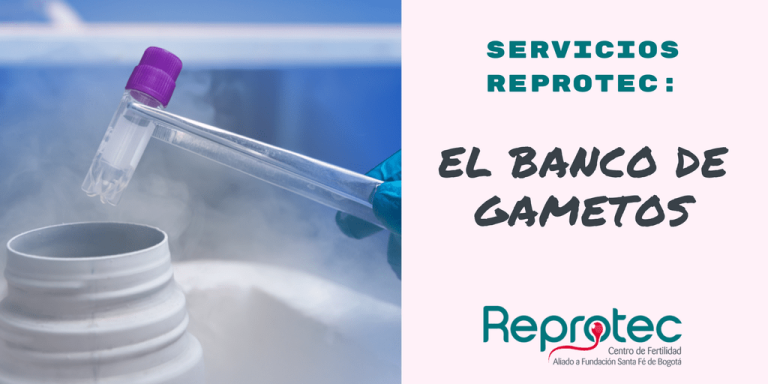
We spoke with Julia Mejía from the Reprotec Gametes Bank, and she told us about the role of the bank in the preservation of fertility, the vitrification process and the importance of this process in cancer patients.
What is the gamete bank?
The gamete bank is, physically speaking, a set of tanks where gametes (which are the eggs and spermatozoa) and the embryos are stored, after the vitrification process.
How does the fertility preservation process begin in cancer patients?
The process for preserving fertility begins with the oncologist, who refers the patient to the fertility center before starting chemotherapy or other cancer treatments that affect fertility.
The ideal is to carry out preservation before the woman undergoes the first cycle of chemotherapy. The best results are obtained when the preservation is carried out as soon as possible, but sometimes it can be done after some treatment, taking into account that fertility can be affected from the first contact with cancer treatments.
In the fertility center, it begins with an ovarian stimulation process, which consists of ripening more than one egg and performing a follicular aspiration to remove the eggs. Three types of ovules are extracted: germinal vesicles that are not used in in vitro treatments, so they do not freeze, M2 that are mature eggs and can be used for an in vitro fertilization treatment, and the M1 that are found in a phase prior to m2 and in some cases they can be used. According to the recommendations of the specialists, the best eggs are selected for the vitrification process.
What is vitrification?
Vytirification is the cryopreservation process that is used in Reprotec. This is a more advanced process than direct freezing, which was the technique previously used.
In the vitrification, it passes through some gradients of sugar concentrations to remove the water from the egg and introduce the cryoprotector, which is the liquid that cares for the eggs of liquid nitrogen and prevents the creation of ice crystals. This process takes approximately 10 minutes and from there it is passed directly to liquid nitrogen and a quick freeze is made.
The previously used direct freezing was carried out in different stages to gradually reduce the temperature. Oocyte survival rates for vitrification are much higher than with direct freezing. From there the eggs pass into the tank where they are kept until now when the patient wants to continue the cycle.
From what age can this treatment be performed?
In cases of preservation of fertility due to cancer, it is ideal that the woman has had her first menstruation. In cases of girls who have not had the first menstruation, ovarian tissue vitrification can be performed.
When is gamete preservation performed and when embryos?
The preservation of eggs is carried out by women who do not have a stable partner, and when the time comes when the woman wants to be a mother, she can use sperm from her partner or from a donor; Preservation of embryos takes place when there is a stable relationship and both parents agree, the ovum and the sperm are joined in the laboratory and after a few days of development they vitrify so that at the time of starting the fertilization process it is only necessary to implant the embryo.
In what cases can the preservation of fertility be carried out?
The preservation of fertility can be carried out not only in breast cancer but also in any type of cancer, including in men with cancer, when treatment can affect the quality of the semen. The gamete bank holds eggs and semen for people who want to preserve their fertility after cancer treatment.
Additionally, the preservation of fertility is one more option that women have to organize our family life. The idea is to relieve the pressure of the biological clock, and allow women and couples to choose the right moment for maternity and family life.
Any message for Reprotec patients?
From the laboratory we work with all our hearts to help couples fulfill the dream of being parents and for us it is a privilege to be able to have life in our hands and every day see how they grow and be able to take care of gametes. I love my job and being able to help those people who have fought so hard to be parents.